What FY2025 CERT Data Reveals About CAMPS Products
Skin substitutes drew a modestly higher disagree rate than the overall Medicare FFS sample — but the error mix and the provider-type variation are where the real signal sits.
CMS recently published the FY2025 Comprehensive Error Rate Testing (CERT) results, and the headline is encouraging: the national Medicare Fee-for-Service improper payment rate dropped to 6.55% ($28.83 billion), down from 7.66% the year prior. That marks the ninth consecutive year below the 10% statutory threshold.
But aggregate numbers only tell part of the story. For those of us working in wound care, an interesting question is: how did CAMPS products fare under CERT review?
I pulled the FY2025 CERT public use file and isolated the claims involving Cellular, Acellular, and Matrix-like Products (CAMPS), the skin substitute category encompassing both application and product codes. Here’s what the data shows.
A Quick Primer on CERT
For those less familiar: CERT is CMS’s annual measurement program for Medicare FFS payment accuracy. Each year, an independent contractor (currently Empower AI, Inc.) draws a stratified random sample of roughly 37,500 claims, requests supporting documentation from providers, and determines whether each claim was paid or denied properly under Medicare coverage, coding, and billing rules.
Claims are adjudicated as either Agree (properly paid/denied) or Disagree (improperly paid/denied). Disagrees are categorized by error type: Insufficient Documentation, Medical Necessity, Incorrect Coding, No Documentation, or Other. Critically, CERT measures payment accuracy. A “Disagree” is not an allegation of fraud, but a finding that the claim didn’t meet Medicare’s requirements as documented.
CAMPS in the FY2025 Sample: By the Numbers
Out of the full CERT sample, 173 unique claims (188 line items) involved CAMPS products, spanning 26 unique HCPCS codes. The vast majority, 82.4%, were Part B claims, with the remaining 17.6% billed under Part A (excluding Inpatient Hospital PPS).
The provider ordering profile for CAMPS was notably diverse:
- Podiatrists accounted for the largest single share at 21.8% of line items
- Nurse Practitioners followed at 16.5%, with Physician Assistants at 10.6%, meaning advanced practitioners collectively represented over a quarter of CAMPS lines
- Dermatologists made up 12.2%
- Surgical specialties (general surgery, plastic/reconstructive, vascular) and institutional settings (inpatient rehab, outpatient hospital, critical access hospitals) rounded out the mix
This distribution reflects the clinical reality of CAMPS utilization: these products are ordered across a wide range of care settings and practitioner types, from wound care centers to podiatric offices to inpatient rehab facilities.
Error Rates: How Did CAMPS Compare?
Here’s where it gets interesting. The CAMPS disagree rate was 16.0%, compared to 14.1% for the overall CERT sample. CAMPS claims were flagged for errors at a modestly higher rate than Medicare FFS claims as a whole.
But the types of errors diverged significantly from the overall pattern:
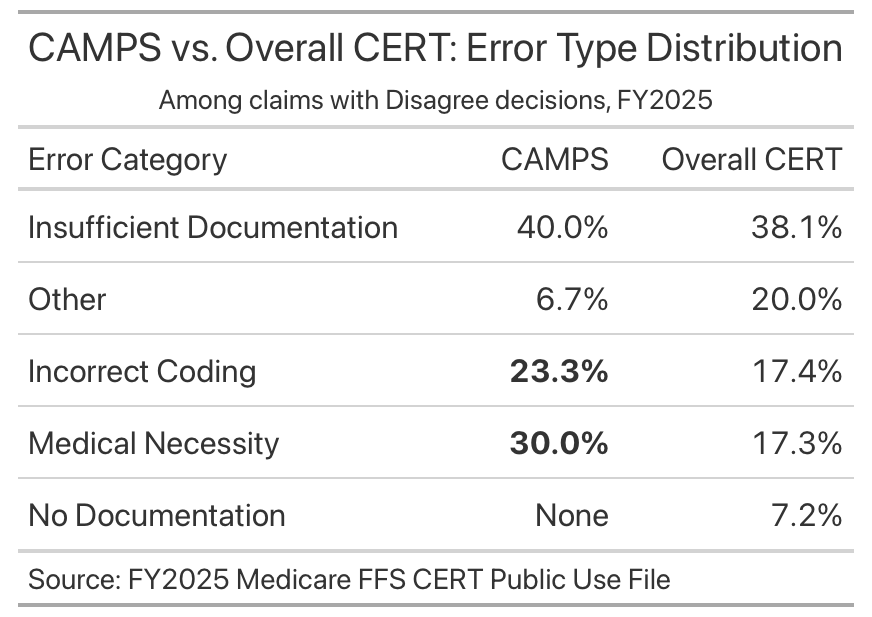
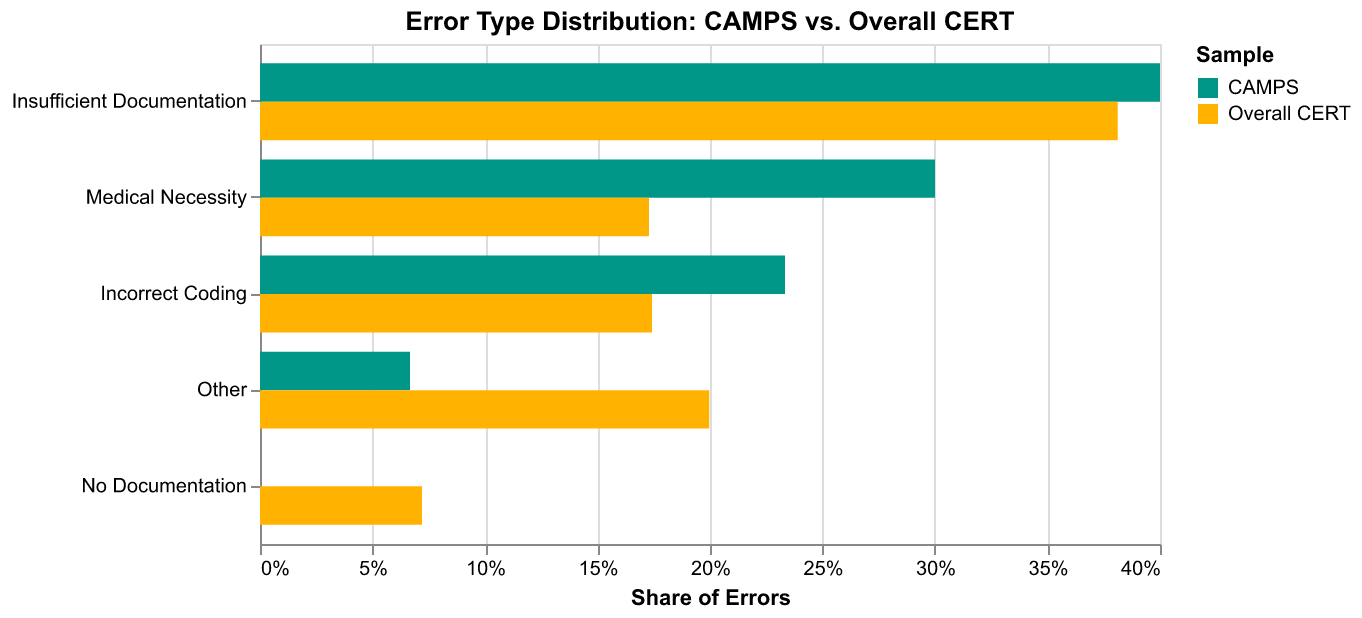
Two findings stand out:
- Medical Necessity errors were nearly double the overall rate (30.0% vs. 17.3%). For CAMPS, this likely reflects challenges in documenting why a skin substitute was the appropriate intervention: wound chronicity, failed conservative treatment, clinical rationale for the specific product selected.
- Incorrect Coding was elevated (23.3% vs. 17.4%). Given the complexity of the CAMPS coding landscape — matching application codes to product codes, with varying units and square centimeter calculations — this isn’t entirely surprising, but it signals an area where providers can tighten compliance.
On the positive side: zero CAMPS claims were flagged for No Documentation, meaning every provider who received a CERT documentation request did submit records. That’s a meaningful compliance baseline.
Where Were Errors Concentrated?
Among the 30 CAMPS line items with errors, the concentration was notable: a single high-volume product accounted for half of all CAMPS errors, and the top two products together represented over 70%. This suggests that error risk in CAMPS is not evenly distributed. A small number of frequently billed products drive a disproportionate share of the findings.
Error Rates by Setting and Provider Type
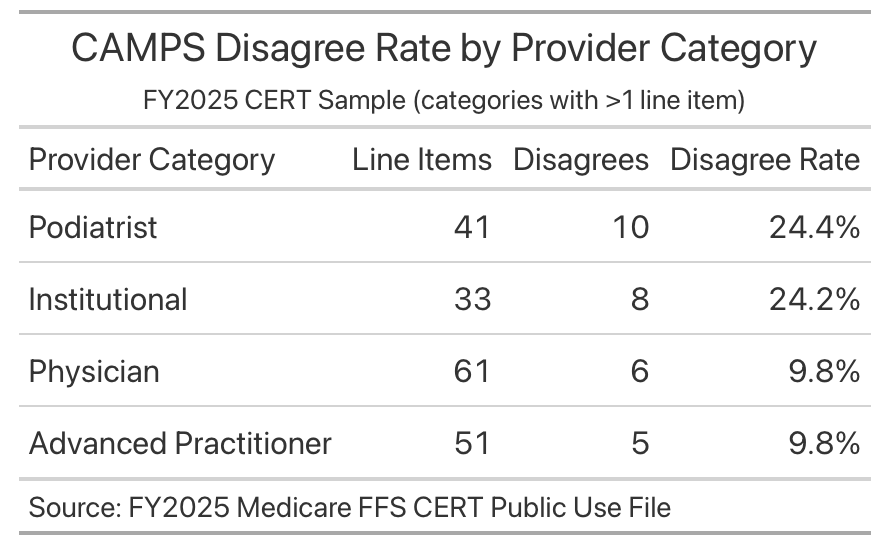
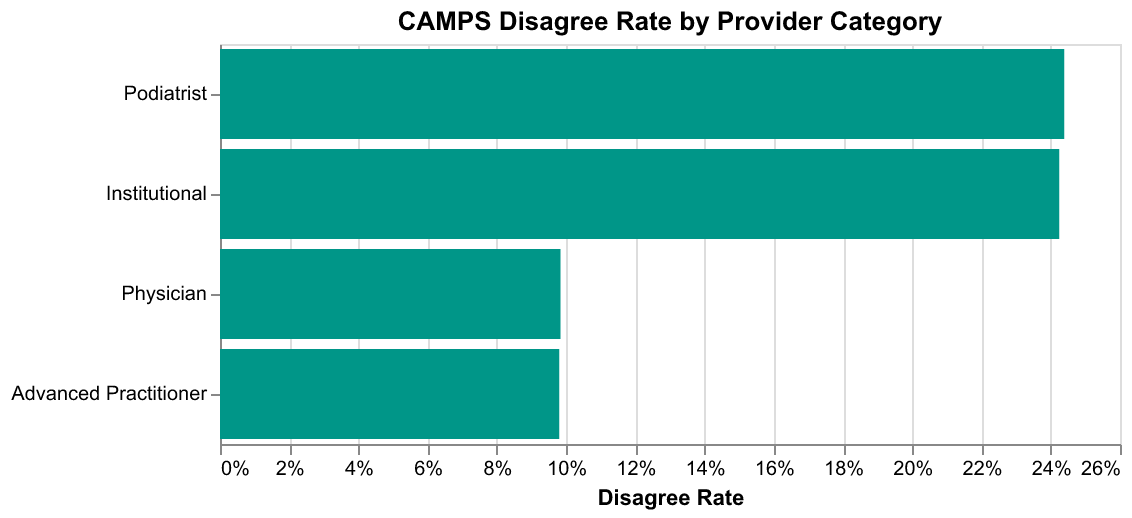
The data revealed meaningful variation by care setting:
- Part A claims (institutional settings) had a 24.2% disagree rate, considerably higher than the 14.2% rate for Part B claims
- Podiatrists and institutional providers had the highest disagree rates among provider supertypes (~24% each), while physicians and advanced practitioners were closer to ~10%
The Bigger Picture
CERT is a measurement program, not an enforcement action, but its findings inform where CMS directs future scrutiny, including Targeted Probe and Educate (TPE) reviews, prior authorization requirements, and Recovery Audit Contractor (RAC) activity. A product category that consistently shows elevated error rates will attract more attention.
The good news: the zero percent No Documentation rate for CAMPS shows that providers are responding to records requests. The opportunity is in the quality of that documentation and the accuracy of the coding.
Analysis conducted using the FY2025 Medicare FFS CERT Public Use File. All statistics derived from the publicly available claims-level data published by CMS.
Comments or questions? Add them under the LinkedIn post.